
McNairy County Criminal Court Cases
McNairy County uses General Sessions Court and Circuit Court for different stages and kinds of criminal work. General Sessions conducts preliminary hearings in felony matters. It may also try misdemeanors when the accused waives grand-jury and jury-trial rights. A felony that moves ahead passes to Circuit Court, the felony-level trial court for the 25th Judicial District. Jury-level criminal matters also belong there. Circuit Court Clerk Ashley Littlejohn keeps the trial docket and related filings for both courts at the McNairy County Justice Complex.
The docket is the best source for what the court did. It can trace a complaint, hearing, bind-over, indictment, plea, trial, judgment, sentence, costs, or appeal. A booking sheet cannot take its place because charges may change after arrest. Municipal courts in Selmer or Adamsville keep their own citation matters within their limited jurisdiction, so a city citation may require a city-court call before any county search. The clerk can help identify whether General Sessions or Circuit holds the record.
McNairy Courts Split Criminal Work
The local split often explains why a single name seems to lead to two files. General Sessions can contain the warrant, first appearance, bond action, and preliminary hearing. If the felony is bound over, later filings and the final judgment may appear under a Circuit Court docket. The State of Tennessee is the prosecuting party, and the 25th Judicial District District Attorney screens charges and presents grand-jury matters. A true bill permits prosecution but does not prove guilt.
Use the court name and docket number together when asking for copies. “Arraignment” means the hearing at which the accused is advised of the charge and enters a plea. “Disposition” means the outcome of a charge, such as conviction, acquittal, dismissal, or another end. A “no true bill” means the grand jury declined to indict. These terms prevent a reader from mistaking an early allegation for the final result.
Searching McNairy County Case Records
No official online search covers ordinary McNairy County trial dockets. The county's LexisNexis link accepts payments; it is not a name or docket search. Start with the McNairy County Circuit Court Clerk at 731-645-1015 or Ashley.Littlejohn@tncourts.gov. The counter is at 300 Industrial Park Drive in Selmer and is open Monday through Friday, 8:00 a.m. to 4:30 p.m. A focused request saves time and reduces the risk of pulling the wrong file.
- Decide whether the matter began in General Sessions, Circuit Court, or a city court.
- Give the clerk the defendant's full name, spelling variants, and a date of birth if available.
- Add the docket number, charge, filing range, and court when known.
- Ask to inspect the docket and identify the disposition, judgment, and sentence entries.
- State whether you need inspection, a plain copy, or a certified copy, then ask for the current cost and delivery options.
| Field | Type | Need | How It Helps |
|---|---|---|---|
| Defendant name | Text | Practical minimum | Include alternate spellings |
| Date of birth | Date | Optional | Narrows common names; public output may truncate it |
| Docket number | Text | Preferred | Identifies the local case directly |
| Court | Choice | If known | Choose General Sessions or Circuit |
| Charge and date range | Text and dates | Optional | Narrows an archive search |
| Copy type | Choice | For an order | Inspection, plain copy, or certified copy |
McNairy Payment Link Is Different
A common mistake is opening the county's “Pay online” link and expecting a docket index. That service is for payments. It does not expose McNairy County criminal court cases by name, charge, or filing date. Tennessee Public Case History is also narrower than its name may suggest. It covers appellate matters rather than routine General Sessions and Circuit trial files.
If a McNairy case has reached an appeal, use the official Tennessee Public Case History as a second layer. Federal prosecutions are separate and appear through PACER for the Western District of Tennessee. For a local trial matter, the clerk remains the direct route by phone, email, counter visit, or a written request tied to an identified docket.
Note: Paying a balance does not show the full case file, prove a warrant cleared, or replace the clerk's current docket.
Inside a McNairy County Case File
A McNairy County case file groups events under a court and docket number. The header may show filing date, status, judge, and division. Party entries identify the State of Tennessee, the defendant, and attorneys of record. Count-level details may preserve both the first charge and an amended charge, which is why the final judgment deserves more weight than an arrest label.
| Case Number and Court | The docket identifier, division, filing date, status, and judge. |
|---|---|
| Charging Document | The complaint, warrant, information, indictment, counts, statutes, and amendments in the file. |
| Docket Entries | A dated list of filings, motions, settings, hearings, capias activity, and appeal steps. |
| Hearing Dates | Initial appearance, preliminary hearing, arraignment, pretrial settings, plea, trial, and sentencing dates. |
| Disposition and Judgment | The result for each count, including plea, verdict, dismissal, nolle prosequi, diversion, or retirement. |
| Sentence and Conditions | Incarceration, probation, credits, fines, costs, restitution, and concurrent or consecutive terms reflected in the judgment. |
Bond details and financial ledgers may appear when public. Social Security numbers, financial account data, and protected victim or minor information are subject to redaction. Some documents may require a counter request rather than a simple docket inquiry.
McNairy Criminal Files Have One Counter
The address matters in McNairy County. The criminal clerk works at the Justice Complex, 300 Industrial Park Drive, Selmer, TN 38375. The older county courthouse and government offices are at 170 West Court Avenue. That second site houses county administration and Chancery functions, so it is the wrong first stop for a current criminal docket. State court-security material reported three county court buildings and three courtrooms, with General Sessions and Circuit assigned to the Justice Complex.
McNairy Circuit Court Clerk
300 Industrial Park Drive
Selmer, TN 38375
731-645-1015
Monday-Friday, 8:00 a.m.-4:30 p.m.
Ashley.Littlejohn@tncourts.gov
The Tennessee courthouse finder provides the statewide official context for McNairy court locations.
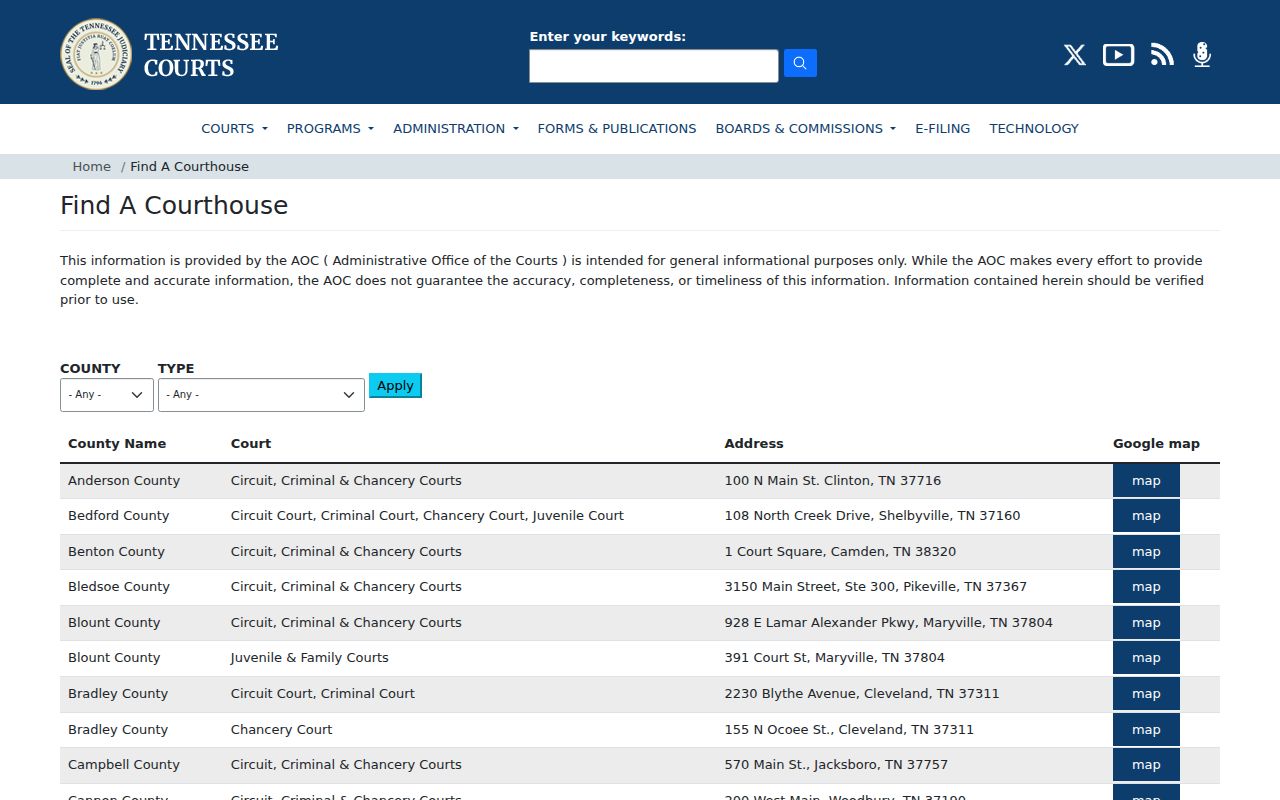
The captured finder illustrates why an official court directory is useful, but the local clerk should confirm where a specific McNairy file is kept.
How a Criminal Case Moves
The path depends on the charge and court. A complaint or warrant can start the case in General Sessions. The accused then receives notice of the charge and may have bond reviewed. A felony may receive a preliminary hearing and move to the grand jury. If indicted, it proceeds in Circuit Court for arraignment, motions, negotiations, a plea or trial, and judgment. Misdemeanors may stay in General Sessions when the required rights are waived.
Case flow: Charges Filed › Arraignment › Pretrial › Plea or Trial › Disposition › Sentencing
The docket may also show diversion. Judicial diversion defers judgment while conditions are completed and can lead to dismissal and expungement. Pretrial diversion postpones prosecution under an agreement. Neither term should be read as a conviction without checking the final order.
Reading McNairy Court Results
Short disposition labels carry large differences. A dismissal ends the charge without a conviction. Nolle prosequi records the prosecutor's decision not to pursue the charge at that time. Acquittal means a not-guilty result. Conviction is a judgment of guilt after a plea or trial. “Retired” is not the same as dismissed for Tennessee expungement purposes and may need to be converted before relief is available.
- Bind-over
- The General Sessions step that sends a supported felony matter onward for grand-jury review.
- Indictment
- A formal accusation returned by a grand jury; it is not a conviction.
- Capias
- Court process commanding arrest, often after a failure to appear or comply.
- Disposition
- The recorded result of each charge, which may differ across counts.
- Certified copy
- A clerk-authenticated copy used when the official form of an order or judgment is needed.
Read the final judgment count by count. A charge class at booking can differ from the offense class that appears in the judgment after amendment, grand-jury review, plea, or trial.
Case Record Access & Restrictions
Tennessee Supreme Court Rule 34 supplies the court-record access framework while preserving confidential material. The Tennessee Public Records Act does not turn one office into a statewide court desk. Ask the McNairy clerk for the file that office maintains. A specific request should identify the name, docket, court, date range, and copy type. The county does not publish plain-copy, certified-copy, search, archive, or scanning fees, so ask for a current quote before mailing payment.
Juvenile files, sealed cases, protected victim and minor data, Social Security numbers, account information, and some active-investigation material are not open like an ordinary adult docket. A public copy may be redacted rather than fully withheld. If a record is absent, ask whether it is archived, sealed, in another court, or not yet filed. Do not infer a result from a blank web search because McNairy has no public trial-docket portal.
Keep McNairy Expungement Orders
Expungement returns to the court where the McNairy County case began. Start by obtaining the docket number and disposition from the clerk. Dismissed charges, no true bill, arrest and release without charge, not-guilty verdicts, and nolle prosequi may fit Tennessee's no-cost categories. A retired case must first become a dismissal, while a dismissal with costs may require the cost issue to be resolved.
The official Tennessee court expungement procedure shows how the request and court order move through the system.
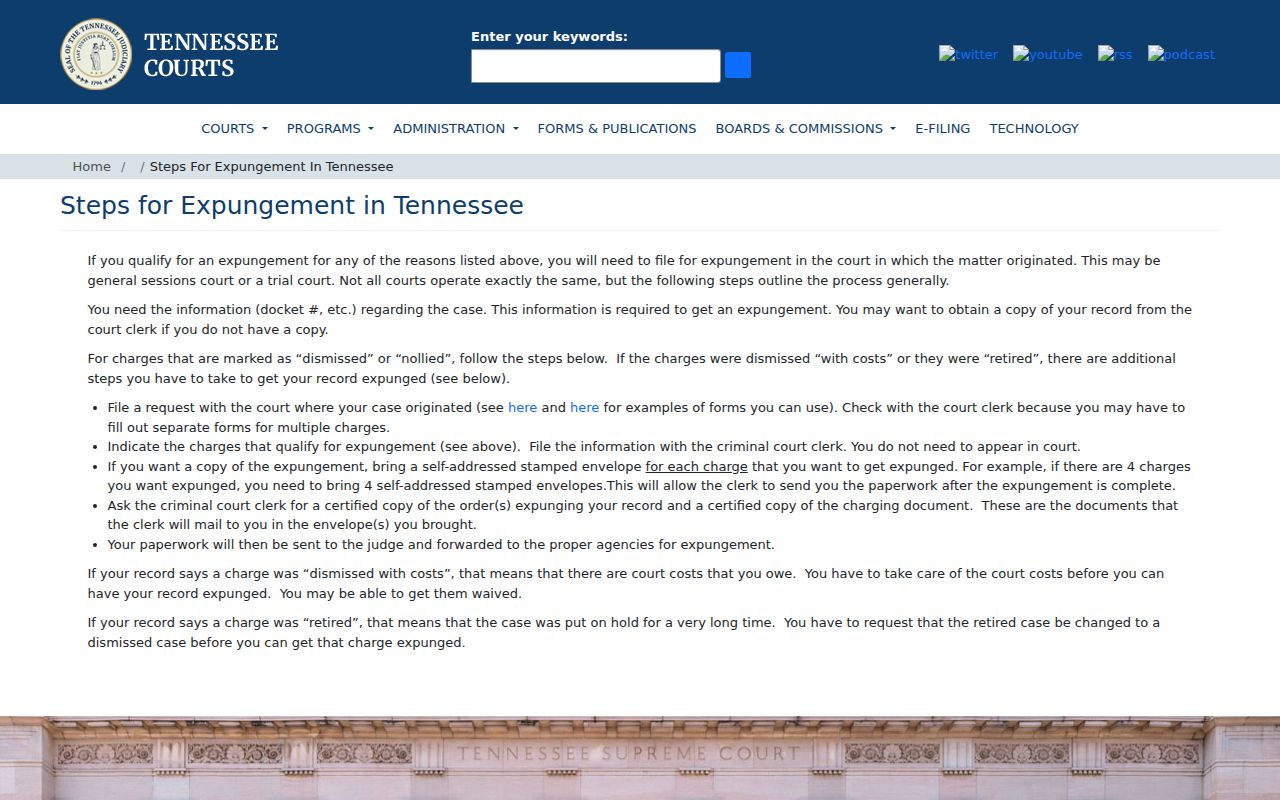
Once granted, ask for a certified expungement order and charging document. The clerk distributes the order to the arresting agency, jail, Tennessee Department of Correction, and TBI. Keeping the certified order gives the person a source document if a downstream record does not update.